
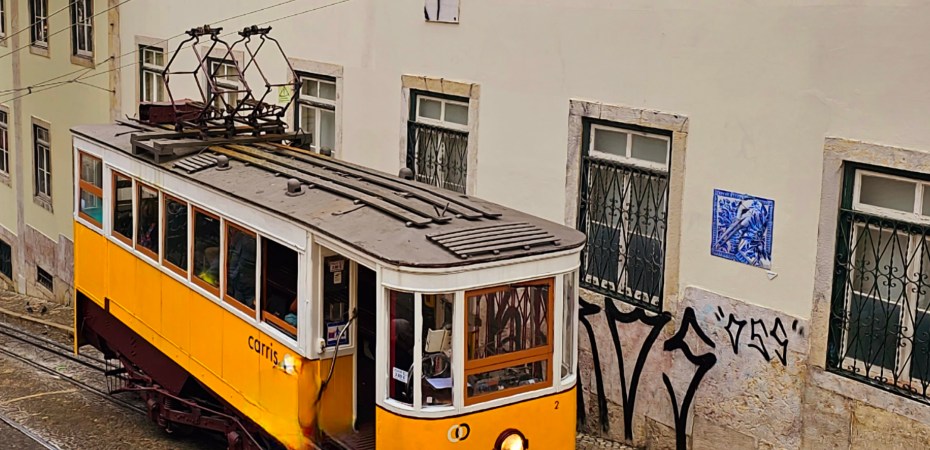
This Sunday, May 5, is UNESCO-designated World Portuguese Language Day. Following is an updated repost from 2022, with new information and a link to an official practice language exam near the end. Keep reading for my collection of Hello, May smiles to start the month.
May 5 is World Portuguese Language Day. The Portuguese language is spoken by more than 255 million people around the world due to Portugal’s history of colonization.

I’ve been studying Portuguese for nearly two years using the free Duolingo app. It was only four months ago, however, that I found out I’d been learning the wrong Portuguese. Because I’m moving to Portugal I need to learn European Portuguese. Duolingo teaches Brazilian Portuguese. There is a difference.
Brazilian Portuguese is easier to learn, speak, and understand because it is a syllable-timed language and therefore more clearly pronounced. European Portuguese is, like English, a stress-timed language where vowel sounds are swallowed (reduced) and pronunciation is not explicit. There are differences in consonant pronunciations too.
Potentially most problematic are the differing word meanings. For example, the word rapiga is a European Portuguese word for girl. In Brazilian Portuguese, though, rapiga means whore or bitch. Pica is European Portuguese for injection, but in Brazilian Portuguese it means prick and is used as slang for penis.
In studying European Portuguese, I’ve already made the mistake of thinking preservativos meant preservatives, when it actually means condoms. I also assumed foda meant lamb or sheep when I first saw images of this annual festival that features a traditional lamb dish called foda. Nope. It’s Portuguese (European and Brazilian) for fuck. Oh boy. Thank goodness I didn’t try asking for lamb without preservatives in Portuguese.



There are other surprising discoveries I’ve made about this rich language. Here are 10 interesting facts about Portuguese:
1
There are about 232 million native Portuguese speakers and approximately 258 million speakers total.
2
It is the fifth most spoken language in the world.
3
Portuguese is the second most spoken romance language in the world after Spanish.
4
It is the third most used language on the Internet.
5
Portuguese is the official language in 10 countries and territories: Brazil, Mozambique, Angola, Portugal, Guinea-Bissau, East Timor, Equatorial Guinea, Macau, Cape Verde, and the Republic of São Tomé and Príncipe.

Click here to watch the YouTube video on World Portuguese Language Day from UNESCO’s website.
6
Only 5 percent of the world’s Portuguese speakers live in Portugal.
7
Brazil has the largest population of Portuguese speakers in the world at 211 million.
8
The United States has 693,000 Portuguese speakers, primarily concentrated in New England, where the 106-year-old Feast of the Blessed Sacrament in Massachusetts is the largest Portuguese festival in the world, according to the New England Historical Society.
9
There are nearly 300,000 Portuguese speakers in both India and Japan, and about 49,000 in Australia. Canada has 222,000.
10
Approximately 60,000 people make up Portugal’s deaf community and they use Portuguese Sign Language.
Don’t speak Portuguese? In Portugal, English is the second most common language. There are more English speakers in Portugal than in Spain.
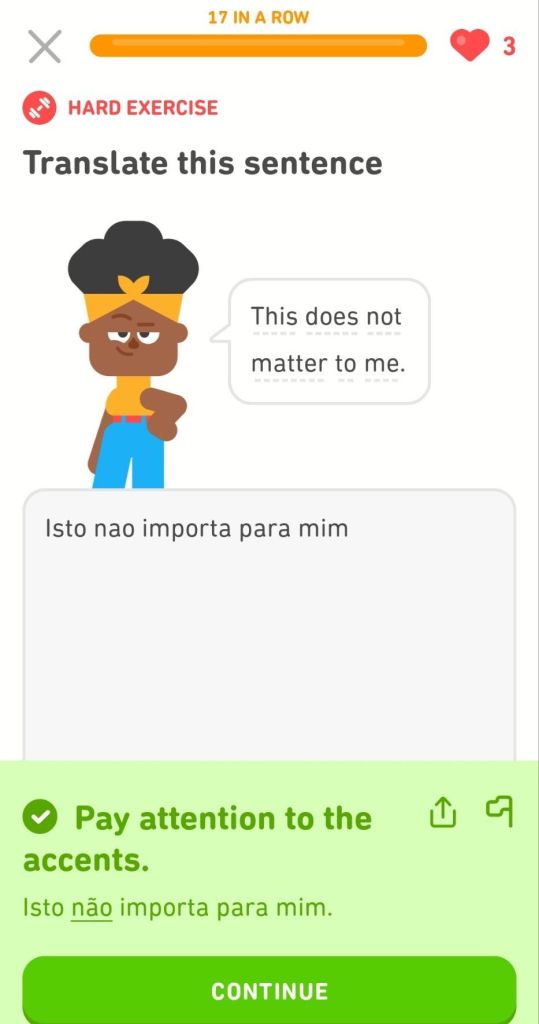
Let me now raise a toast to May 1, 2024, marking 19 months as a solo midlife expat living my dream life in Portugal. At this point, I’ve been studying Portuguese off and on for more than three years, yet I still struggle with speaking, listening, and grammar. As noted in the above repost, I began my language learning in the U.S. by inadvertently studying Brazilian, not European, Portuguese. Now that I’ve lived in Portugal for more than a year-and-a-half, I’ve heard from language teachers, the media, and Portuguese natives that Brazilian grammar is becoming predominant in Portugal due to music and the Internet. Brazilian Portuguese is widely spoken here and is universally understood by European Portuguese people. I’ve come to realize that many of my interactions are with people who are speaking Brazilian Portuguese. It’s also more convenient to practice learning on-the-go with the free and easy-to-use Duolingo app. For this reason, I’ve added Duolingo back to my language-practice routine, supplementing my European Portuguese workbooks and flashcards. Differentiating between examples and non-examples is an effective learning tool that’s helping to slowly boost both my European and Brazilian Portuguese language skills.
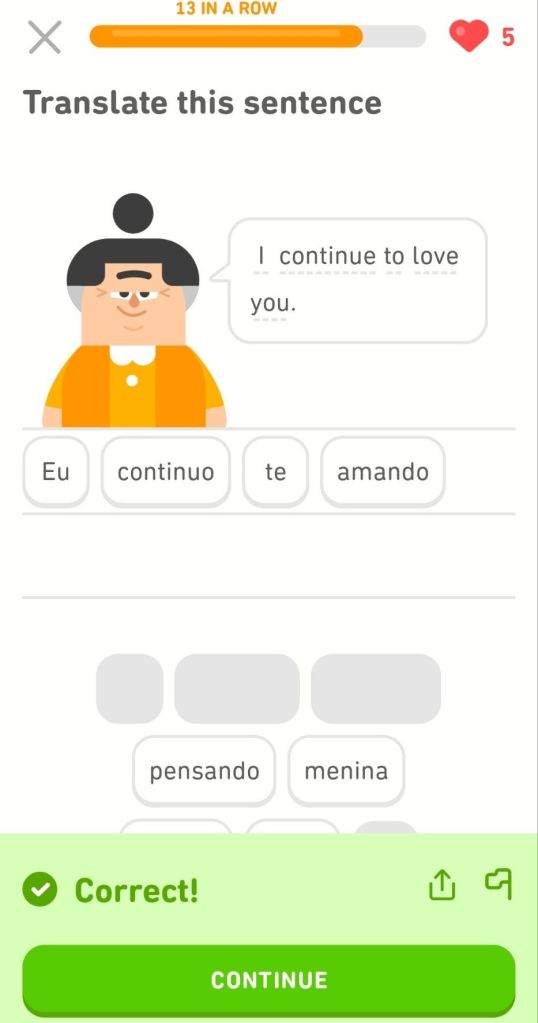
Duolingo is sweet…
In roughly three more years, I’ll be eligible to apply for citizenship here. That will require me to score at least 55 percent on the CIPLE European Portuguese language exam at Level A2. An F grade will get me by. Good thing. I recently took this practice exam online and scored 95 percent on reading comprehension. My score on oral comprehension — listening to audio clips of conversations twice and then answering multiple choice and matching questions — was only 64 percent, confirming what I already know is my area of weakness. Let’s be honest. Listening is not my strength in English, either.
The practice exam also includes two extended response questions — writing an email and writing a text — that are not scored online. After I finished the practice exam, I scanned my two written responses into a translation app, and they appeared to be correct, mais ou menos. In addition to reading comprehension, oral listening comprehension, and writing extended responses, the actual exam includes a speaking component where you have a live conversation with a test administrator. The entire two-hour exam is administered in a testing center. Headphones are not used. There is one 15-minute break. The cost to take the exam is 79 euros.
This sounds relatively easy. If I were 8.
At 64, I have extreme difficulty hearing the word sounds in fluent (fast AF) spoken Portuguese. I also randomly forget known words in my own native language, so speaking Portuguese always makes me a tad nervous. I do it all the time, but I am slow and choppy. I am not a confident Portuguese speaker. Unless I’ve had a glass or two of wine…or if I’m pissed off. I don’t think test administrators will look kindly on an angry and tipsy immigrant, though, so that scenario will not work in my favor. My practice continues. Luckily, I have three years.
Hello, May
In addition to my Portuguese reading comprehension score, here is what has me smiling as we start the month of May. Sources are unknown.

And where is TTML?




Thank you for reading! 💜 May your week find you smiling and fluent in the universal language of gratitude.

Information sources: Babbel, World Atlas
The Hot Goddess
Instagram: retired_rewired_inspired
If you enjoyed this please remember to Share, Like, Follow, Comment, Subscribe. (This is my “call to action” I’m supposed to include in every post. Thanks so much for your support!) ❤
Copyright ©️ 2021-2024 thehotgoddess.com. All rights reserved.

 The Hot Goddess
Happy Portuguese Language Day, Natalie. You had me laughing all the way through this post. You’re excellent at describing even plain old facts in an amusing way. Isn’t there another interesting fact about Portuguese, that when Portugal separated from Spain they made a new language just so they wouldn’t be speaking Spanish, and made it quite different from Spanish? A Portuguese-Canadian friend told me this once long ago. I love that you’re looking to apply for citizenship. 💕
LikeLiked by 1 person
Quite the error: preservativos meant preservatives, when it actually means condoms. Preservativos must be to preserve the current state of your uterus.
You’ve come a long way!
LikeLike
Who knew and thank goodness you caught the error when you did.
It’s the kind of mistake I would have made 🙂
LikeLike
Great post. I didn’t know that there are more English speakers in Portugal than in Spain. Interesting and shocking. Thank you for that bit of information and pictures. The one with old nurse vaccinating the little girl was hilarious.
LikeLiked by 1 person
🤣🤣🤣 Such interesting (and hilarious) facts about the Portuguese language and your experience in learning it, Natalie! Hmmm, you’d think the Fuck Fair would be the largest Portuguese festival in the world…or at least the most popular 😉.
Deb
LikeLiked by 1 person
Thanks for the F— Fest Natalie and the many laughs. I love Brazilian music, partly for the sound of the language, but don’t understand the words. I really don’t want to try to learn a new language, which might limit my ability to move abroad. Kudos on your feisty and fun perseverance. 😊
LikeLike
I wondered if Portueguese was similar to Spanish, which I learned in the 5th-9th grades. I can still pick out words in conversations but you are right about what it taught and how the language is spoken among natives. Still you have proven that our minds are not old, just our bodies. Imagine your brain as a file cabinet with 64 years of files. It takes a while to retrieve them but they are stored safely
LikeLike
Muito bom, Natalie. Have fun practicing Portuguese – even fighting with a namorado can increase fluency. Wine always increases fluency, as you know 🙂 Happy 19 monthaversary!
LikeLiked by 2 people
A person could get into a lot of trouble if they hadn’t learned the language.
LikeLiked by 1 person
Oh yes. Yes I can.
LikeLiked by 1 person
Happy Portuguese Language Day, goddess.
LikeLiked by 2 people
Obrigada, Dawn 💜
LikeLike
Oh man, you made me laugh so hard with those memes! 😀 Anyway, learning a new language is both fun and challenging. But in three years, I can envision you passing the language exam with ease. You seem to be doing very well now, Natalie. Keep practising, and Happy Portuguese Language Day! ❤
LikeLike
You’re on my bucket list 👀❤️
LikeLike
I tried to leave a long, thoughtful comment, but WP is acting like a donkey. Let’s just say, I agree with some of these memes lol
LikeLike
Crazy to see that only 5% of Portuguese speakers are in the borders of Portugal.
LikeLiked by 1 person
I know, very surprising to me as well. Brazilian Portuguese dominates, on the Internet and in music too.
LikeLiked by 1 person
Certainly does but when you also consider there are also more Portuguese residents outside the borders than within them, that’s a globally spoken language.
LikeLiked by 1 person
Pois 😊
LikeLiked by 1 person